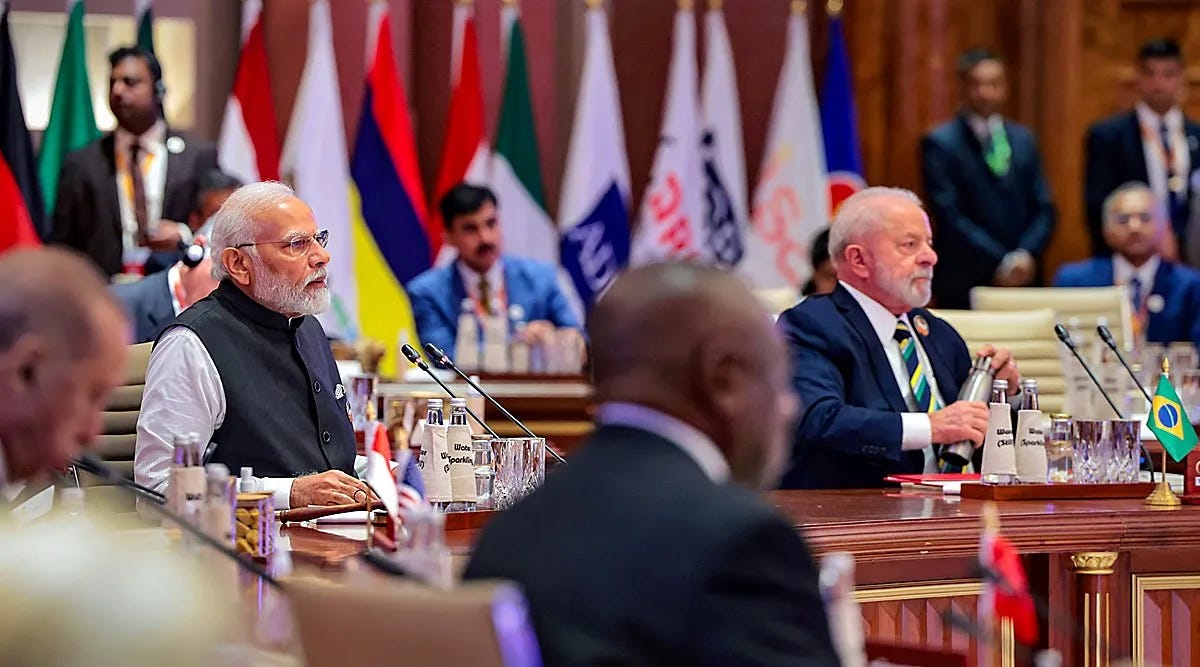
Iran and the United Arab Emirates couldn’t agree on a joint statement as recently as May 2026. In September, in New Delhi, they signed the same one.
So did India and China. Their border quarrels have cost lives within the decade. So did Brazil, Russia, South Africa, Egypt, Ethiopia and Indonesia, along with outreach partners drawn from four continents. Ten member states finished a hundred and forty paragraphs of text at Bharat Mandapam sometime past midnight on 13 September, and when the gavel fell there was no dissent recorded against a single line. Most Western newsrooms filed it as a footnote to whatever their own governments had said that week. It deserves more than a footnote. Much more. Though not for the reasons its own drafters would probably give it.
The content of the New Delhi Declaration is not, on its own, the story. Coalitions of convenience produce documents constantly, and most of what this one asks for (an end, under Article 101 of the UN Charter, to any single country’s hold on the UN’s senior posts; a Security Council reshaped around Brazil and India, with China and Russia’s backing on record; IMF quotas that reflect where the world’s output now actually sits; a WTO dispute mechanism restored to working order after years of being left to atrophy) has been asked for, in one form or another, since at least the 1990s. Read closely, the declaration doesn’t ask to escape the rules-based order so much as to have the same rules enforced against whoever currently ignores them most freely. What is unusual is how the request was made. Nobody dictated these paragraphs to the room. Four hundred preparatory meetings across thirty cities fed into a single overnight drafting session among governments that agree on almost nothing else. The final text had to survive contact with every one of their disagreements before it could produce a sentence all ten would sign.
That’s a different way of building order from the one the last eighty years trained the world to expect. The postwar architecture was never, in practice, built this way. It was drafted mostly by the victors of one war for the world that emerged from it, and its coherence came from having a centre: a reserve currency, a court, a security council with permanent seats, an institution able to grant itself exceptions to the very rules it wrote for everyone else. Unilateral sanctions worked as the enforcement mechanism of that order, precisely because one actor could impose them without needing anyone’s agreement. Dues could be withheld to paralyse an institution while the withholder remained, on paper, one of its members. None of it required consensus. It required a centre willing to act, and a periphery unable to prevent it.
What was negotiated overnight in Delhi runs on the opposite logic. A payment system that lets ten mutually suspicious treasuries settle trade without routing through anyone else’s clearing house is not fast, and it’s certainly not decisive. But it doesn’t depend on any single actor’s goodwill either. A development bank still finding its feet, an investment platform, a shared guarantees initiative, an insurance risk lab housed at GIFT City: none of it is dramatic. This is little more than plumbing, and slow plumbing at that. But plumbing built by ten parties who trust none of the others fully is a fundamentally different structure from a single pipe controlled by one player. Redundancy, in this sense, looks like waste and functions as the substitute an order without a centre builds in place of a veto it doesn’t have.
Beneath the diplomacy sits something less official and considerably more widely shared: an exhaustion that a warehouse worker in Ohio recognises about as easily as a cocoa farmer in Ivory Coast; the exhaustion of a working life spent producing, extracting and repaying on terms set elsewhere, without ever quite being permitted to call the amount enough. That exhaustion was palpable in New Delhi. Its presence filled the room with urgency, far more than any of the paragraphs on Security Council seats. But New Delhi doesn’t answer it so much as redistribute who gets to cause it next. The payment systems, the investment platform, the tariff zero-rating: these still run on the same appetite for more and more stuff that built the order they’re trying to replace, only with many more hands now reaching for the same tap. A world with several centres competing to extract, produce and consume faster than the others is not obviously gentler on a river system, a coastline or a workforce than a world with one centre doing it. What has not been negotiated in any communiqué yet, from Bretton Woods to Bharat Mandapam, is a settlement with the planet itself about how much is enough, and who gets to decide when unrelenting material growth has done its work and should simply stop.
Something similar is happening one layer up, within the infrastructure of thought rather than of trade. A repository for sharing open digital rails, a feasibility study for cables that don’t have to pass through anyone’s chokepoint, a joint commitment to shared principles on artificial intelligence: taken together, these read less like policy items than an attempt to build the nervous system of a coordination architecture that has no single brain. Whether that attempt succeeds will matter more than whichever government currently leads it. The alternative is a handful of firms and one or two states holding the processing power and the cables on which everyone else’s intelligence increasingly runs: a centre of its own, quieter than a currency and harder to negotiate with.
Even on the conflicts where any one of these ten governments had reason to walk out, the same logic holds: disagreement gets absorbed into softer language rather than settled by any single voice with the standing to decide. The declaration records concern over Gaza’s humanitarian toll without adjudicating the war that produced it. For the first time, it includes a paragraph on Cuba’s blockade, a subject that could easily have split hosts from guests, yet doesn’t. On the wider tensions surrounding Iran, it calls for restraint without pointing to a side responsible for the nuclear risk it admits has grown. What holds these clauses together is less a position on any one war than a wager that security itself is indivisible: that a bloc whose members’ safety depends on someone else’s insecurity isn’t secure at all. That kind of resolution is weaker than a decision in any single moment, and may be sturdier across the many moments a decision would have to survive.
None of this makes the arrangement admirable simply because it’s plural. China’s extension of zero tariffs to fifty-three African economies, and the biodiversity fund it has bankrolled out of Kunming, are generosity and leverage at once, and the same declaration that speaks for ten equal parties still shows one member deciding more than the rest. Elsewhere the declaration insists that voluntary contributions should never buy governance influence, a rule this bloc’s largest member has more reason than most to test. Horizontal doesn’t mean flat; the largest members of a consensus order still do more to shape the architecture than the smallest, and the chair passing from New Delhi to Beijing for 2027 is itself a small lesson in whose gravity still bends the orbit: the institutional machinery needed to turn this year’s feasibility studies into next year’s actual cables and clearing houses sits disproportionately with one member. Nor does the carbon border argument resolve cleanly in either direction, real as the underlying unfairness may be. The states that filled two centuries of atmosphere are now proposing levies on states still trying to industrialise, while the climate finance promised since Rio in 1992 remains largely undelivered. What changed in Delhi was not who is right about any of this. Something else changed: the mechanism by which anyone gets heard at all.
And here’s the more troublesome matter sitting underneath the summit, the one that will outlast this declaration and this chairmanship handover. For three-quarters of a century the closest thing the world had to a single point of view, however partial and however contested, sat in Washington and, at one remove, in Brussels. That vantage point was never actually universal. It only had the standing to behave as though it were. That fiction bought it a speed no negotiated body can match. New Delhi is what it sounds like when that fiction starts losing its grip: a room full of governments that have stopped waiting for anyone’s permission to disagree with it out loud. A single actor can decide overnight to freeze an adversary’s reserves, strike a facility, or reroute a supply chain, because it doesn’t have to wait for anyone else’s agreement. Getting thirty capitals to agree on a single paragraph costs four hundred meetings and one exhausting night. Getting one capital to act costs a phone call.
That difference in cost is about to matter more than it ever has, and not only for reasons of diplomacy. A pandemic doesn’t have the patience to wait for a chairmanship to rotate. A cascading grid failure doesn’t pause for the seventh draft of a clause. An AI system behaving in ways its own developers can’t fully explain will not remain still while thirty foreign ministries find language everyone can sign. Many of these emergencies are not simply misfortune arriving to test an otherwise sound arrangement. They are closer to what an economy organised around the assumption that more is always better tends, sooner or later, to produce: an industrial world-system pushed so hard that it hands back a new pathogen, a grid sized for appetite rather than for resilience, and an intelligence built at whatever pace competition demands, not the pace caution would counsel. Several centres racing toward that horizon generate the same pressures a single one would, only from more directions at once.
The order taking shape in meetings like Bharat Mandapam is legitimate in a way the old one rarely bothered to be, earned through the consent of parties who agree on almost nothing else. But legitimacy built through deliberation and speed built through command have, until now, lived in different institutions, and no one has yet built one that reliably holds both.
Modi called what emerged from New Delhi a roadmap rather than a destination, and said the years ahead owe the world results rather than further statements of intent. Results, in the vocabulary this declaration speaks, still mean growth: more trade routed through more channels, more capacity, and then more capacity again. Ten governments spent one exhausting night proving that consent among unequal, mutually suspicious parties is still possible, and that achievement deserves to be recognised as real. But nobody in that room spent the night asking whether growth itself, however evenly the next version of it gets shared out, remains the most sensible principle on which to organise a planet’s economy. That question outlasts every chairmanship, and unlike the ones that filled New Delhi’s paragraphs, it doesn’t wait for a rotation to come due. The atmosphere has already answered two centuries’ worth of it without a single vote being cast. A species that keeps deferring the question of enough doesn’t get to defer what not asking it costs. Nobody has scheduled it for 2027, or for any year after. The planet keeps no such calendar.